How to Prepare for Your Masters of Psychology Practice Ethics Class Using Prep Tips?
- Charmayne Paul

- 6 days ago
- 5 min read
Quick Answer:
Your Masters of Psychology (MPP) ethics class helps you bridge theory and practice by applying ethical competencies, legislation, and professional values to real-world psychology work. It’s less about memorising rules and more about learning to reason, reflect, and act ethically in complex, human situations. What You’ll Learn in Your Masters of Psychology Practice Ethics Class
Ethics isn’t about memorising codes — it’s about applied reasoning and reflection.
Your personal values and professional duties will sometimes collide.
Journalling helps develop ethical maturity and decision-making transparency.
You’ll explore real-world dilemmas using PsyBA competencies and Australian legislation.
How to get prepping for class early ~ as ethical fluency builds over time, not overnight.
Why This Class Matters: Ethics Is the Foundation of Practice
The first term of your MPP is more than just coursework ~ it’s your initiation into professional psychology thinking. Masters level ethics sets the tone for everything that follows. You’ll revisit codes (now competencies) you might’ve skimmed in undergrad, but now with a more applied focus. Especially how to think, decide, and act when the answer is not black-and-white.
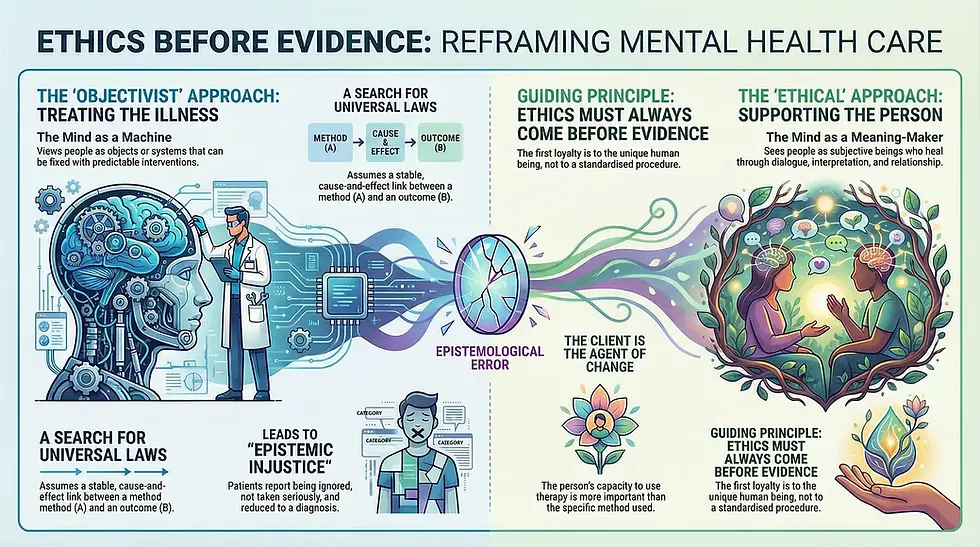
Think of Masters of Practice ethics in psychology as your compass: not to make you perfect, but to help you be more accountable and critically reflective. Your personal worldview still matters ~ in fact, it’s one of your greatest tools for insight~ but now it meets the professional framework required. Traditionally this was the APS code of ethics (rescinded as of December 2025), now the PsyBA’s Code of Conduct (in place as of December 1st). How Do Personal Values Interact with MPP Professional Ethics?
Your personal values don’t disappear when you enter professional life ~ they evolve alongside your psychology practice. The PsyBA doesn’t demand moral conformity, but it does require ethical fluency: the ability to reason through tensions between personal belief and professional obligation.
Here’s the part most Masters of Psychology Practice students underestimate: value misalignment isn’t failure. It’s feedback. If a workplace or client population challenges your worldview, that’s an opportunity to refine your understanding of your value boundaries. Knowing where those boundaries lie helps you choose practice areas where you can sustain compassion and professional framework competence. Pro Tip: Start journalling before the term begins. Reflect on everyday ethical situations ~ in media, conversations, or even films. Link them to PsyBA Competencies and relevant legislation. This builds early reflective reasoning muscle, rather than aiming to memorise 'what I should say'. I've collated a Pinterest board of Journalling examples here

How to Use Journalling for Ethical Reflection
Journalling isn’t just “Dear diary ...” It’s an analytical tool ~a quiet lab for your ethical mind as a soon-to-be practitioner of psychology.
Try this structure:

Over time, this transforms your journal from emotional notes to critical reflective writing — evidence of your ethical fluency. What Core Frameworks Will You Study?
Your Masters of Pscyhology Practice ethics unit anchors you in the major professional frameworks shaping Australian psychology:
PsyBA Code of Conduct (2025)
The Privacy Act 1988 (Cth)
The Privacy and Other Legislation Amendment Act 2024 (Cth)
Freedom of Information Act 1982 (Cth)
Your state/territory’s Health Practitioner Regulation National Law (the National Law), Mental Health Act, and Mandatory reporting laws.
These aren’t just boxes to tick ~ they’re 'live' instruments guiding professional integrity. As you work through case studies in your Masters program, you’ll analyse scenarios where competencies clash.
What Does an Ethical Dilemma Look Like in Practice?
An example ethical tension: Competency vs. Evidence-Based Practice.
Imagine a graduate psychologist following a treatment model so rigidly that it limits authentic engagement with the client. Professional judgment (PsyBA Competency 2.1) is expected of the psychology practitioner, however critical evaluation of literature evidence is also expected (Competency 1.2).
So, what happens when strict fidelity to evidence-based practices threatens relational connection? That’s an ethical dilemma. The solution isn’t a “rule,” but a reasoned stance. This is where critical reflective dialogue (and supervision) come in~ to help you decide when adaptation is sound professional judgement, not deviation. Thinking, Not Memorising: Why Critical Reflection Aids Psychology Practice
Psychology isn’t mechanical. You’re not applying formulas; you’re engaging people. One argument is that ethics-first thinking reminds us that humans aren’t predictable systems that theories and models may portray. That “The map is not the territory.”
Sometimes psychology aims to mimic the predictability of the natural sciences, however, several argue that real-world psychology practice is hermeneutic (interpretive) (e.g., Ekeland, 2021 in Knizek & Klempe, 2021). It's person-to-person work, not a cut-and-dry explanation. Each client’s experience is unique and relational, not replicable, and not easily explained.
That’s why ethics isn’t a hurdle ~ it’s a dialogue between you, your client, and your professional conscience. Application of Ethics: A Process, Not Perfection
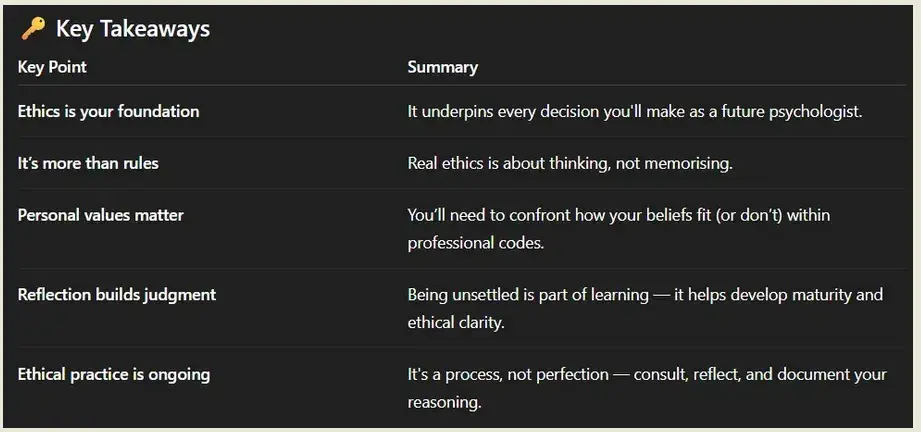
If you take only one thing from this Masters of Psychology Practice ethics class prep: ethical practice is not about getting it right every time. It’s about how you communicate your approach for decision-making.
The most skilled psychologists don’t claim certainty ~ they demonstrate how they reasoned. They consult with more experienced others and read more. They document via critical reflection and structured reports. They reflect on how their personal beliefs, the unique context, and their professional frameworks intersect and or diverge.
That’s ethical maturity, moving from “I know a competency” to “I can justify my choice of competency in this situation.” You’ll stumble sometimes. Everyone does. The goal isn’t flawlessness application, it’s accountability and growth.
So, as Term 1 approaches, start building the reflective habits that will support you long beyond your Masters coursework.
Final Thought ~ Get Prepping!
Ethical reasoning is a required professional practice for graduate psychologists. The ethics class is not just a course requirement. The more you explore your values now, using critical thinking, the stronger your foundation as a reflective, responsible, and competent psychologist.
Next Step~
Set up your ethics journal and jot your first reflection. Ask yourself: Where have I recently noticed an ethical tension — and how could I reason through it?
You’re not preparing for a class. You’re preparing for the professional you’re becoming.
FAQs
1. What is the purpose of the Masters of Professional Practice ethics class? To help you apply ethical competencies and related legislation to real-world psychology contexts; and to develop critical reflection skills for transparent ethical decision-making.
2. How can journalling help in ethics training? Critical reflective journalling promotes ethical fluency ~ the ability to trace your reasoning and understand your decisions, not just state them.
3. What ethical frameworks guide Australian psychology students? The PsyBA Code of Conduct (2025) replaces the APS Ethical Guidelines (2010), and laws like the Privacy Act 1988 (Cth) and state and territory's mandatory reporting laws.
4. What happens if my personal values clash with professional expectations? It’s normal. Critical reflection helps you navigate these tensions.
5. Is ethics about getting everything right? No. Ethics is about thoughtful transparent reasoning, accountability, and professional growth ~ not perfection.


Comments